

Его возраст одиннадцать тысяч лет,то есть в два раза старше египетских пирамид.
Высота 5,3 метра.
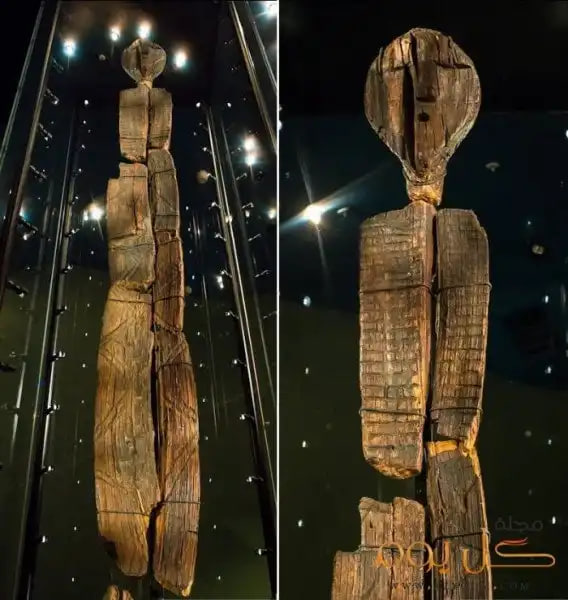
Найден в 1890 году при разработке золота у нынешнего г.Кировграда (Свердловская область).
В настоящее время хранится в Свердловском областном краеведческом музее .
В 2017 году в Екатеринбурге проходила международная конференция «Большой Шигирский идол в контексте искусства каменного века Северной Евразии».
Участие в ней приняли специалисты со всего мира.
Я тоже "заглянул на огонёк" про приглашению университетского товарища,ныне ответственного сотрудника Института археологии УрО РАН,который и занимается в основном изучением этого уникального артефакта.
Заодно был повод повстречаться с сокурсниками и преподавателями,с которыми не один сезон провели в археологических экспедициях.
"Идола" мы изучали в своё время,но как то в памяти у меня эти знания не особо отложились.
Потому задавал вопросы и получал на них ответы "из первых рук".
Во первых возраст.
Очень долго спорили о нём,ученые не могли придти к согласию.
Решили вопрос немецкие ученые,применив комбинацию двух методов - подсчета годовых колец и радиоуглеродного анализа .
А трассологический анализ, проведенный ведущим научным сотрудником Института археологии РАН М.Жилиным, позволил узнать, из чего, как и чем древние уральцы вырубали Идола.
Крупную лиственницу раскололи, ,подровняли теслами из кремня. Отшлифовали кремниевыми же стамесками.
Голову вырезали инструментом из челюстей бобра.
Жилин отметил,что челюсть бобра создана самой природой для "столярных работ". ))
Да и мелкие выемки сложно делать.Рот,глаза. Поэтому такие инструменты из бобров и использовались.
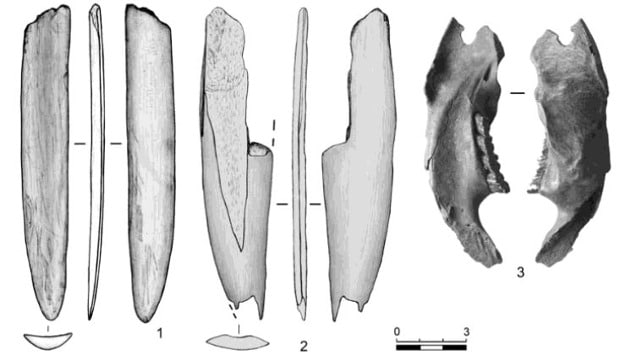
Орудия, найденные на стоянке Береговая 2. 1,2 — костяные ножи, 3 — орудие из нижней челюсти бобра
The Great Shigir Idol is the oldest surviving wooden sculpture in the world.
Its age is eleven thousand years, that is, twice as old as the Egyptian pyramids.
Height 5.3 meters.
Found in 1890 during the development of gold near the present city of Kirovgrad (Sverdlovsk region).
Currently stored in the Sverdlovsk Regional Museum of Local Lore.
In 2017, the international conference “The Great Shigir Idol in the Context of Stone Age Art of Northern Eurasia” was held in Yekaterinburg.
Experts from all over the world took part in it.
I also “looked at the light” about the invitation of a university friend, now a responsible employee of the Institute of Archeology of the Ural Branch of the Russian Academy of Sciences, who is mainly engaged in the study of this unique artifact.
At the same time, there was an opportunity to meet fellow students and teachers with whom we spent more than one season on archaeological expeditions.
We studied “Idol” at one time, but somehow this knowledge was not particularly imprinted in my memory.
Therefore, I asked questions and received answers to them “first-hand.”
Firstly, age.
They argued about it for a very long time, scientists could not come to an agreement.
German scientists solved the problem by using a combination of two methods - counting tree rings and radiocarbon dating.
And the trace analysis carried out by M. Zhilin, a leading researcher at the Institute of Archeology of the Russian Academy of Sciences, made it possible to find out from what, how and with what the ancient Urals cut down the Idol.
Large larch was split and trimmed with flint adzes. They polished it with silicon chisels.
The head was cut out with a tool from the jaws of a beaver.
Zhilin noted that the beaver’s jaw was created by nature itself.
And it’s difficult to make small indentations. Mouth, eyes. That's why such beaver tools were used.
Tools found at the Beregovaya 2 site. 1,2 - bone knives, 3 - a tool from the lower jaw of a beaver

Comments